
How to Calculate FOV in AI Cameras
Introduction
Field of View (FOV) is one of the most critical parameters in AI vision systems. It determines how much of the scene your camera can capture and directly impacts:
• object detection accuracy
• coverage area
• camera placement
• lens selection
In this guide, we’ll explain how to calculate FOV and provide a practical calculator you can use immediately.
• object detection accuracy
• coverage area
• camera placement
• lens selection
In this guide, we’ll explain how to calculate FOV and provide a practical calculator you can use immediately.
FOV Calculator for AI Cameras
Calculate field of view, scene size at distance, compare common lenses, and estimate the required focal length for your target scene width.
Input Parameters
Required Focal Length
Main formula: FOV = 2 × arctan(d / 2f)
Results
Horizontal FOV
—
Vertical FOV
—
Diagonal FOV
—
| Sensor Diagonal | — |
|---|---|
| Scene Width at Distance | — |
| Scene Height at Distance | — |
| Scene Diagonal at Distance | — |
| Required Focal Length | — |
| View Type | — |
Enter parameters and click Calculate.
Common Lens Comparison
Quick comparison for common focal lengths with the selected sensor and distance.
| Lens | Horizontal FOV | Vertical FOV | Diagonal FOV | Scene Width | Scene Height | Typical View |
|---|---|---|---|---|---|---|
| No data yet. | ||||||
How to Use This FOV Calculator
This calculator helps you quickly estimate the field of view (FOV) and scene coverage for your camera setup.
Step-by-step:
1. Select sensor format
Choose a preset (e.g. 1/2.8") or enter custom sensor dimensions.
2. Enter sensor size
Input sensor width and height (in mm or inches).
3. Set focal length
Specify the lens focal length (e.g. 2.8 mm, 3.6 mm, 6 mm).
4. Enter distance to object
This defines how far the scene is from the camera.
5. Click Calculate
You will get:
✅ Horizontal / Vertical / Diagonal FOV
✅ Scene width and height at distance
✅ Required focal length (reverse calculation)
✅ Lens comparison (2.8 → 16 mm)
✅ View type (Wide / Medium / Narrow)
💡 Pro Tip
If you are designing an AI vision system:
• Start from required scene width
• Then calculate focal length
• Only after that choose the lens
👉 Not the other way around
Step-by-step:
1. Select sensor format
Choose a preset (e.g. 1/2.8") or enter custom sensor dimensions.
2. Enter sensor size
Input sensor width and height (in mm or inches).
3. Set focal length
Specify the lens focal length (e.g. 2.8 mm, 3.6 mm, 6 mm).
4. Enter distance to object
This defines how far the scene is from the camera.
5. Click Calculate
You will get:
✅ Horizontal / Vertical / Diagonal FOV
✅ Scene width and height at distance
✅ Required focal length (reverse calculation)
✅ Lens comparison (2.8 → 16 mm)
✅ View type (Wide / Medium / Narrow)
💡 Pro Tip
If you are designing an AI vision system:
• Start from required scene width
• Then calculate focal length
• Only after that choose the lens
👉 Not the other way around
What is FOV?
Field of View (FOV) is the angle that describes how wide the camera sees the scene.
There are 3 main types:
• Horizontal FOV
• Vertical FOV
• Diagonal FOV
There are 3 main types:
• Horizontal FOV
• Vertical FOV
• Diagonal FOV
FOV Formula
The core formula is:
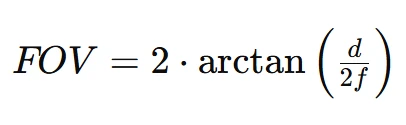
Where:
d — sensor size (mm)
f — focal length (mm)
d — sensor size (mm)
f — focal length (mm)
Types of FOV Calculations
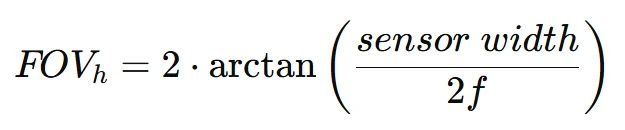
Horizontal FOV
Vertical FOV

Diagonal FOV

FAQ
What is the most important FOV parameter?
Horizontal FOV is usually the most important for real-world applications, especially for surveillance and robotics.
Why does FOV decrease when focal length increases?
Because the lens becomes more “zoomed in,” reducing the visible angle of the scene.
What FOV is considered wide?
• Wide: > 90°
• Medium: 50–90°
• Narrow: < 50°
How accurate is this calculator?
It provides a very good approximation for most AI camera systems.
However, real-world results may vary slightly due to:
• lens distortion
• sensor cropping
• ISP processing
Should I use diagonal FOV?
Diagonal FOV is useful for spec comparisons, but for engineering:
👉 use horizontal + vertical FOV
How do I choose the right lens?
It depends on:
• distance to target
• required detail (pixels per meter)
• scene size
👉 This calculator helps you estimate the geometry, but not resolution requirements.
Horizontal FOV is usually the most important for real-world applications, especially for surveillance and robotics.
Why does FOV decrease when focal length increases?
Because the lens becomes more “zoomed in,” reducing the visible angle of the scene.
What FOV is considered wide?
• Wide: > 90°
• Medium: 50–90°
• Narrow: < 50°
How accurate is this calculator?
It provides a very good approximation for most AI camera systems.
However, real-world results may vary slightly due to:
• lens distortion
• sensor cropping
• ISP processing
Should I use diagonal FOV?
Diagonal FOV is useful for spec comparisons, but for engineering:
👉 use horizontal + vertical FOV
How do I choose the right lens?
It depends on:
• distance to target
• required detail (pixels per meter)
• scene size
👉 This calculator helps you estimate the geometry, but not resolution requirements.
Designing an AI Camera System?
Choosing the right sensor and optics is critical for achieving reliable detection, accurate measurements, and optimal system performance.
At ATEH.tech, we design custom AI vision systems, including:
- Custom camera modules (Sony IMX sensors)
- Lens and optics selection
- Jetson & Rockchip-based embedded platforms
- Full system integration (hardware + firmware)